English 134 Portfolio

Drafting
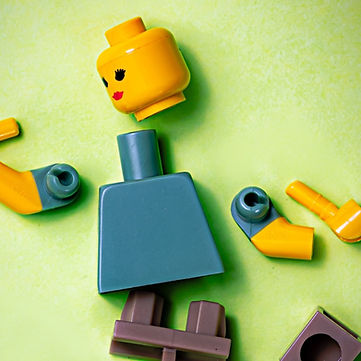
For me, my first ideas are a mess of Legos on the ground, different shapes, sizes and colors all mixed together. Drafting can be a chaotic and messy phase consisting of multiple lists, random sentences, outlines and a jumble of words seemingly thrown onto a word document. As described in my first sequence, my brain can be quite a mess of ideas which can be reflected in all of my drafting documents. As I get all my thoughts onto a document, I then slowly start to sort those Legos into groups, picking out the ones that are the most important to the project. I decide what I want my end project to look like and choose pieces of information that best reflect what will most effectively get my point across to the audience. Then once everything is sorted and ready, I can start building based on my outline. Adding blocks on top of each other and moving blocks around until I have something that resembles a structure or at least something that someone can start to recognize. Without drafting, I wouldn’t be able to have a cohesive, concise, and organized idea to start my writing process. In my opinion, I think drafting is the most essential writing stage for me since I struggle with getting my thoughts laid out.
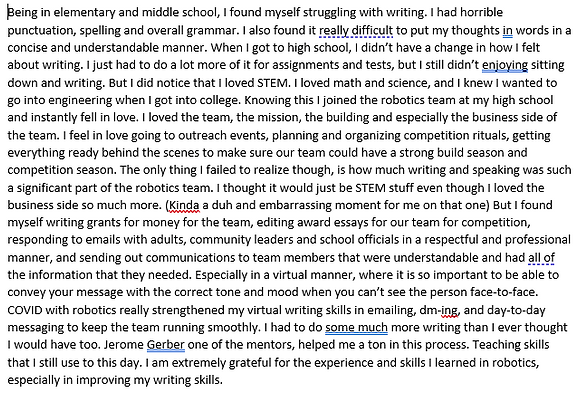
In the first week of class, we took time to brainstorm different topic ideas for the narrative essay. During this brainstorming, I thought I was going to write my literacy essay about joining robotics in high school and having to learn new skills in writing- especially in a COVID setting. I gained a lot of valuable skills with writing in a virtual environment where tone and mood are even more significant to convey the message I wanted. The process artifact to the right, is one of the guided writing processes I wrote in class when we were brainstorming for this essay. As I thought about my topic more, I realized that while it was a good topic for the essay, I wanted to do something more personal to my writing journey. I sat down with my brainstorming writing again, re-read the answers to my writing feelings assignment, and decided to go with more of the struggles I faced while writing. This is a direct example of EO 3, “Recognize that writing and rewriting are necessary to the discovery, clarification and development of ideas”. I used my class writing assignments and brainstormed ideas to develop a new idea for my literacy essay. In the end, I completely switched my topic from what I was initially thinking, but I think my final product is a much stronger and more impactful essay.
Sequence 1

Sequence 2
When I first started brainstorming for this sequence, I was stuck on who I wanted to interview and what change I wanted to talk about. At first, I thought I was going to interview my dad but I felt like that was too “safe” of an option and I wanted to get more out of my comfort zone with this project. I am really interested in the shops on campus, and I really enjoy having Eric as a teacher, so I thought that this project was a great way to get to know him more and learn more about the shop, as well. Drafting the guided writing practice was a great way for me to get all of my ideas down and start organizing. I also thought about interviewing my roommate as another idea to get my brain thinking outside the box for this essay. As I thought more about talking with Eric, I started getting really excited about discussing the shop with him and the Learn By Doing motto at Cal Poly, so I knew I had to go with that idea. This guided writing practice is also a perfect example of how my initial drafting phrase can be very messy, with lots of bullet points and ideas that are all over the place. Like groups of Legos scattered across the floor, I would start to sort through all my thoughts to find the concept I was most excited about building upon. I always like to get out all of my ideas, even the crazy ones, because you never know what connections you can make that will result in the best idea.
Similar to the last essay, I also struggled with coming up with a good topic for this sequence. Originally, I wanted to write about a whole different topic but it didn’t fit with the essay prompt, so I had to do a 180 and go back to brainstorming. When talking with my dad about my own financial aid situation, I realized that the idea was staring me right in the face. As I moved forward with thinking about tuition differences at California higher education schools, I was very overwhelmed with all the routes I could take with the essay. This resulted in numerous outlines and organizational lists like the writing artifact to the right. I chose this one specifically because it was the outline that I liked the most and what I followed when drafting my first writing. With this draft, we can again see my messy list strategy of organizing my thoughts in order to start planning my essay. Without this outline, I wouldn’t have been able to effectively write a cohesive essay that strongly persuaded my audience on my position. Outlines like these are crucial to my writing process and help me to develop my ethos, logos, pathos and karios in a meaningful way for the audience.
